Best Ratchet Straps for Motorcycles: What to Buy and How to Strap
In this guide
The short answer: a 1-inch or 1.5-inch ratchet strap with latched S-hooks, used in a set of four with a soft loop at each attachment point, is the right tool for almost every motorcycle that fits in a pickup bed or on a single-axle trailer. Pick straps by the working load limit (WLL) on the label, not the break strength in the listing title, aim for a combined WLL at least equal to the bike’s weight, and compress the forks part way, never all the way. This is a spec-based review: it compares published ratings and features and explains what they mean for a bike, with no invented test results.
Disclosure: As an Amazon Associate I earn from qualifying purchases. AUGO, featured below, pays a bonus commission through Amazon Creator Connections. See /disclosure/.
What a motorcycle strap actually needs
A motorcycle is a tall, heavy load balanced on two small contact patches, and it is being held down against its own suspension, so the job is different from strapping a crate. Five things matter.
| Spec | What to look for | Why |
|---|---|---|
| Width | 1” to 1.5” | Fits soft loops, triple clamps and trailer D-rings; 2” straps are overkill and often will not thread through a soft loop |
| Working load limit | Printed on the label; combined WLL >= bike weight | The WLL is the rating you are allowed to use; break strength is roughly three times higher and is the number listings advertise |
| Hooks | S-hooks with a safety latch, or snap hooks | A latch keeps the hook in the soft loop or D-ring if the strap goes slack over a bump |
| Soft loops | Included, or buy a set | Webbing-to-webbing contact at the bike; no scratched paint, no hook sliding off a round tube |
| Length | 8 to 15 ft | Enough to reach low, wide anchor points on a trailer; retractables at 10 ft are fine in a truck bed |
The WLL point is the one that catches people. A strap sold as “2,200 lb” is almost always quoting break strength. The industry design factor, as stated by the Web Sling and Tie Down Association and by most strap makers, is 3:1, so that strap’s WLL is about 733 lb. That is still far more than a quarter of any motorcycle, which is why 1-inch straps dominate this category. Read more in working load limit vs break strength.
The comparison, by published spec
Specs below are from the maker’s site or the Amazon listing as of October 2026. Break strength (BS) is what most listings quote; where the maker states a WLL it is shown, otherwise the implied 3:1 figure is marked. Confirm the printed label on the strap you receive; that number wins.
| Strap | Size | Rated strength (per listing) | WLL | Hooks | Soft loops | Best for |
|---|---|---|---|---|---|---|
| AUGO Heavy Duty 4-pack (featured) | 1” x 15 ft | 2,200 lb BS | ~733 lb implied | S-hooks, safety latch | 4 included | Street bikes, cruisers, trailer hauling |
| AUGO Retractable 4-pack | 1” x 10 ft | 1,200 lb BS | 400 lb stated | S-hooks | Included, plus bag | Dirt bikes and mid-weight bikes in a truck bed |
| AUGO Heavy Duty 1.5” 4-pack (not linked; confirm current listing) | 1.5” x 10 ft | 4,400 lb BS | ~1,466 lb implied | S-hooks, safety latch | 4 included | Heavy touring bikes, trikes |
| Rhino USA 4-pack | 1” x 15 ft | 1,823 lb BS | ~607 lb implied | S-hooks, latch | Included | Street bikes |
| Rhino USA Retractable 2” 2-pack | 2” x 10 ft | 3,033 lb BS | ~1,011 lb implied | S-hooks | Included | Heavy bikes in a truck bed |
| STANLEY S1007 | 1.5” x 16 ft | 3,300 lb BS | 1,100 lb stated | S-hooks | Not stated | Heavy bikes on a trailer |
| Amazon Basics 4-pack | 1” x 15 ft | 1,500 lb BS | 500 lb stated | S-hooks | Not stated | Budget set for light bikes |
| PowerTye, Ancra (motorcycle-specialist brands) | Mostly 1” to 1.5” | Varies by model | Varies | Often built-in soft ties | Built-in on some models | Riders who want integrated soft ties |
PowerTye and Ancra are the long-running motorcycle-specialist brands and both make straps with sewn-in soft ties; their current ASINs and ratings change often enough that this guide does not quote a number for them. Check the label on the model you are looking at.
Featured (disclosed relationship)
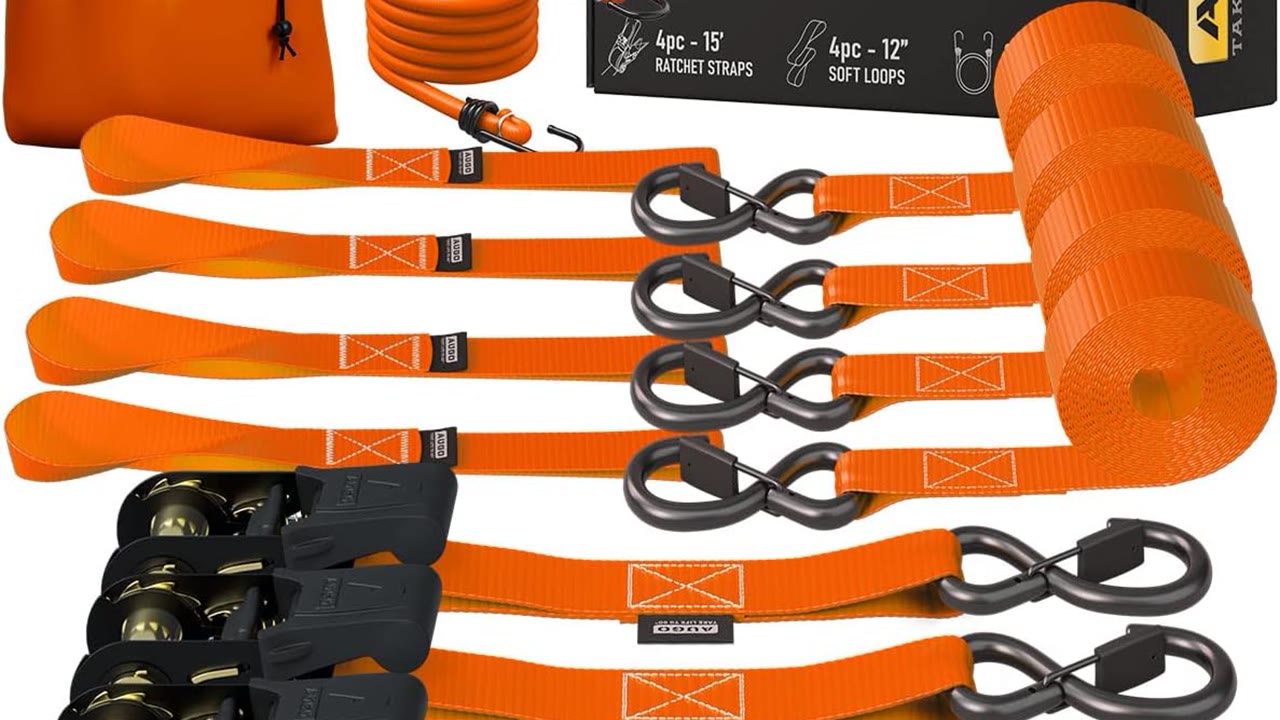
AUGO Heavy Duty Ratchet Straps 4-pack, 1" x 15 ft. Listed at 2,200 lb break strength (about 733 lb WLL at the 3:1 industry ratio; the listing states break strength, so confirm the WLL on the label), latched S-hooks and four soft loops in the box. Four straps give an implied aggregate WLL near 2,900 lb, several times the weight of any street motorcycle, and the 15 ft length reaches low trailer anchors with room to spare. Seven colors. Check the current price on Amazon.
Not for: trailer decks, cars or anything that calls for a 2-inch, 3,000 lb-plus WLL strap. It is a 1-inch light-duty strap, and that is exactly why it suits a motorcycle.
Which strap for which bike
Dirt bikes and small dual-sports (under 300 lb). Almost any 1-inch strap is strong enough; the risk is over-compressing a long-travel fork, not strap failure. The AUGO retractable set at 400 lb WLL each is a tidy choice for a truck bed because the webbing winds itself up and there is no tail to tie off. Cam-buckle straps also work here, though they hold tension less reliably than a ratchet.
Street bikes, nakeds and sport-tourers (400 to 600 lb). The AUGO Heavy Duty 4-pack or the Rhino USA 4-pack. Four 1-inch straps with latched hooks and soft loops, 15 ft long so they reach the floor D-rings of a trailer at a wide angle.
Cruisers, baggers and touring bikes (700 to 900+ lb). Step up to 1.5-inch webbing: the AUGO 1.5-inch set at 4,400 lb break strength or the STANLEY S1007 at a stated 1,100 lb WLL. The wider ratchet also has a longer handle, which makes tensioning against a heavy bike’s springs easier.
Trikes, sidecars and bikes over 1,000 lb. Treat them as general cargo: see the counts and aggregate WLL math in how many ratchet straps do I need and consider 2-inch straps on the heaviest axles.
How to strap a motorcycle, step by step
The sequence below is assembled from Rhino USA’s tie-down guide, RevZilla’s solo-loading guide, etrailer’s FAQ and the Honda CRF owner’s manual. Where they differ, the differences are noted.
- Chock the front wheel. A wheel chock holds the bike upright while you work and stops the front wheel walking in transit. Rhino USA calls it optional but strongly recommended; without one, press the front tire against the trailer’s front rail or a solid block and check the straps more often.
- Choose the front anchor on the bike. The lower triple clamp is the first choice in every source consulted. Fork legs just below it, with a soft loop, are the alternative. Handlebars are a secondary point only; RevZilla notes that on many sportbikes the lower triple is unreachable, in which case use the bars or clip-ons but never the rubber grips without a bar harness.
- Fit the soft loops. Wrap the loop around the clamp or tube, pass one eye through the other and pull it snug, then hook the strap into the free eye. Route the loop clear of brake lines, cables and wiring; Honda’s manual specifically warns against straps touching control cables.
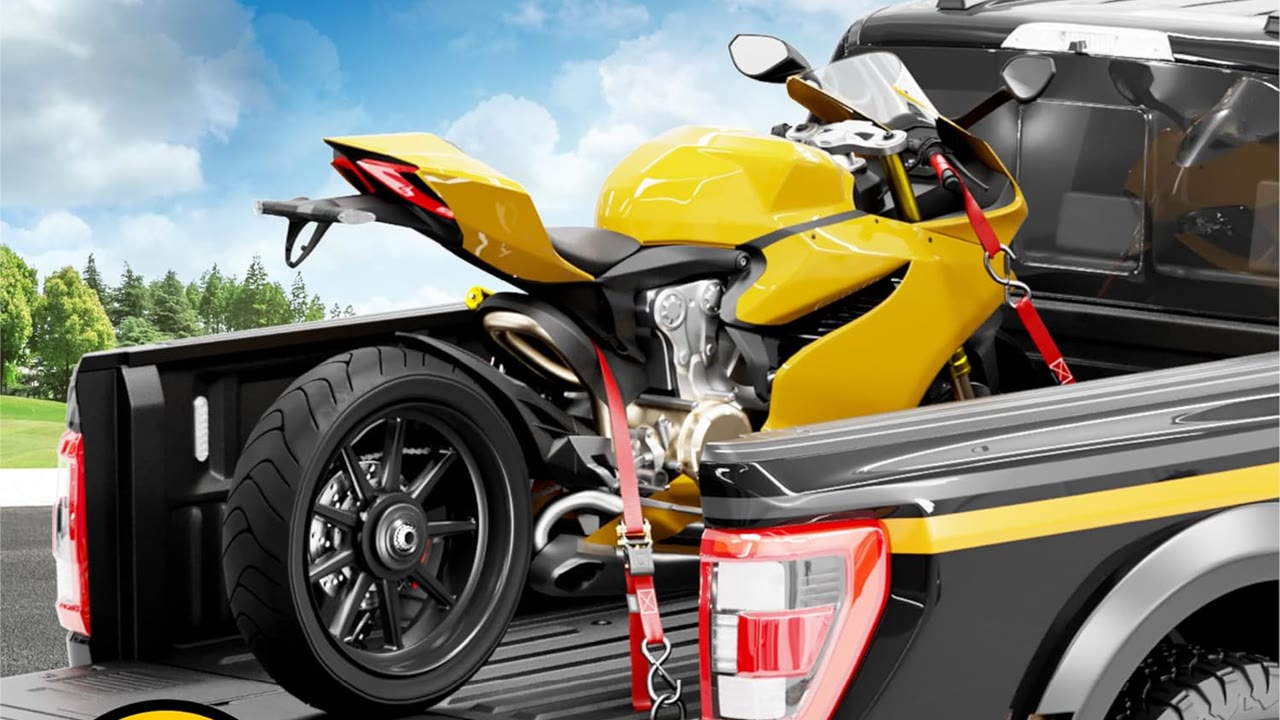
- Set the front straps. Hook each front strap to a floor anchor well forward and well outboard of the bike, so each strap runs down and out at about 45 degrees. Take up slack on the left strap with the bike still on its sidestand, then tension the right strap while pushing the bike upright; it lifts off the stand and the fork starts to compress, which also tightens the left side. Alternate sides a click at a time until the bike stands straight.
- Compress the forks part way. Honda says about half-way and warns that more can damage the seals; Rhino USA says about a third. Stop as soon as the bike is upright with no slack. Never bottom the fork: a fully compressed fork cannot absorb bumps, and the straps then take every shock load.
- Add the rear pair. Soft loops on the swingarm or subframe, straps down and outward to the rear anchors, light tension only; the rear straps stop side-to-side and rearward movement, they do not need to compress the shock. Never use footpeg mounts or the exhaust.
- Raise the sidestand, leave it in gear, engine off. Rhino USA adds: never transport a bike on its center stand.
- Tie off the tails and shake test. Knot or bundle the loose webbing so it cannot flap or feed back into the ratchet. Grab the bike and push: bike and trailer should move together. Recheck after the first 10 to 20 miles and after any hard stop.
For the ratchet mechanics themselves, threading, taking up slack and releasing, see how to use ratchet straps and, if the pawl jams at the end of the trip, how to release a stuck ratchet strap.
How much strap is enough
Two numbers bracket the answer.
The federal cargo rule (49 CFR 393.106(d)) requires the aggregate WLL of the tie-downs to be at least half the cargo weight, with a direct tie-down counting for half its WLL. A 600 lb bike therefore needs 300 lb of aggregate WLL, which four straps of 150 lb WLL would satisfy. That rule legally applies to commercial vehicles over 10,001 lb GVWR in interstate commerce, not to a pickup towing a bike to a track day, but it is the only published math and it is the floor, not the target.
The practical target quoted by etrailer is a combined WLL that exceeds the bike’s weight, and Rhino USA recommends at least 500 lb WLL per strap. Four straps from any set in the table above clear both targets for any bike under about 1,200 lb.
What that margin buys you is not strength against a static load. It is headroom for the dynamic loads of a trailer hitting a pothole with 600 lb of sprung mass trying to leave the deck, and for the strength you lose to angle: a strap at 45 degrees applies only about 70 percent of its tension vertically. See tie-down angle and working load limit for the math.
Mistakes that bend bikes and drop them
- Trusting the headline number. “2,200 lb” is break strength. Divide by three and use that.
- Bottoming the forks. Seals, bushings and springs are not meant to sit fully compressed for 300 miles. Half travel or less.
- Hooks straight onto the bike. Bare S-hooks slide along round tubes and chew paint. Use soft loops; AUGO’s 6-pack of soft loops is listed at 1,500 lb load capacity and 4,500 lb break strength, which is far more than the strap pulling on it.
- High, narrow anchors. Straps that run nearly vertical do nothing against sideways rocking. Go low and wide, roughly 45 degrees.
- Pegs, mirrors, exhaust, plastics. None of them are designed for strap loads.
- Releasing a ratchet with the bike leaning on it. Ratchets let go all at once. Have a hand on the bike, release the opposite side first and lower the bike onto its sidestand.
- Frayed or cut webbing. 49 CFR 393.104 bars damaged or weakened tie-downs, and the same logic applies to anyone’s bike. Inspect before every trip and retire straps with cuts, burns or stiff, sun-faded webbing; see how to store and inspect ratchet straps.
Ratchet vs cam buckle for a motorcycle
Cam buckles are easier to release and impossible to over-tension by hand, which is why kayak owners use them. On a motorcycle the problem is the opposite: a ratchet holds its click under vibration, and you need several hundred pounds of tension to compress a fork and keep it there. Rhino USA’s guidance is that cam straps suit small dirt bikes or serve as backup straps, and that ratchets are the primary tool. The full trade-off is in cam buckle vs ratchet straps.
The rules, briefly
If the bike rides on a commercial trailer at 10,001 lb GVWR or more in interstate commerce, 49 CFR Part 393 Subpart I applies in full: aggregate WLL at half the cargo weight, minimum tie-down counts, no damaged straps, edge protection. For a personal pickup or trailer the governing law is the state unsecured-load statute, for example Washington RCW 46.61.655, which makes a load that comes loose and causes injury a gross misdemeanor. The FMCSA math remains the soundest rule of thumb on either side of that line; the full breakdown is in cargo securement rules for pickup trucks and trailers.
Bottom line
Buy a four-pack of 1-inch straps with latched hooks and soft loops for anything up to a mid-size cruiser; the AUGO Heavy Duty 4-pack is the featured pick here and the Rhino USA 4-pack is the closest alternative. Go to 1.5-inch webbing for a bagger or touring bike. Chock the front wheel, soft-loop the lower triple clamp, pull the fork down to no more than half travel, add a light rear pair, and check everything again 15 miles down the road.
Frequently asked questions
How many ratchet straps do I need for a motorcycle?
Four is the standard: two at the front pulling down and outward at roughly 45 degrees, two at the rear. Two front straps are the bare minimum for a light bike in a chock. Rhino USA, etrailer and the Honda owner's manual all describe at least one rear strap in addition to the front pair.
What working load limit should motorcycle straps have?
A conservative target is a combined working load limit at least equal to the bike's weight, which for four straps on a 600 lb bike means 150 lb WLL each. Most 1-inch straps clear that easily. Rhino USA recommends at least 500 lb WLL per strap, which gives a wide margin on a heavy cruiser. Always read the WLL on the label, not the break strength in the listing title.
Should I use soft loops on a motorcycle?
Yes. A soft loop chokes around the lower triple clamp, fork leg or frame tube and gives the strap hook a webbing eye to grab, so bare metal never touches paint or polished parts and the hook cannot slip off a round tube. Most motorcycle-oriented strap kits include them; AUGO sells a separate 6-pack.
How far should I compress the forks when tying down a motorcycle?
Honda's CRF owner's manual says to tighten until the front suspension is compressed about half-way and warns that more pressure can damage fork seals. Rhino USA suggests about one-third of travel. Either way, never bottom the forks out; a fully compressed fork cannot absorb bumps, and your owner's manual wins over any general advice.
Can I attach the straps to the handlebars?
Only as a secondary point. The lower triple clamp is the preferred front anchor because it is low, wide and structural. Several manufacturers warn that handlebars can bend under strap load, and rubber grips can rotate. Check your owner's manual before using bars or clip-ons.
Are retractable ratchet straps strong enough for a motorcycle?
The AUGO retractable 4-pack is listed at 400 lb working load limit per strap, so four of them total 1,600 lb WLL, which is more than double the weight of most street bikes. They suit lighter bikes and tidy truck-bed hauling; for a 900 lb touring bike on an open trailer, a standard 1-inch or 1.5-inch strap with more webbing is the better fit.
Keep planning
- AUGO Heavy Duty Ratchet Straps Review (4-Pack, 15 ft, 2200 lb)
Spec-based AUGO heavy duty ratchet straps review: what the 1 in x 15 ft, 2,200 lb set is rated for (about 733 lb WLL), who it fits, and what it is not for.
Updated Oct 2026 - How Many Ratchet Straps Do I Need? FMCSA Rules Made Simple
How many ratchet straps you need by cargo length and weight, using the FMCSA tie-down count and aggregate working load limit rules, with worked examples.
Updated Oct 2026 - How to Use Ratchet Straps: Thread, Tighten, Release, Tie Off
How to use ratchet straps step by step: thread the mandrel from below, keep 2-4 wraps, tighten without crushing the load, release the pawl and tie off the tail.
Updated Oct 2026