How Many Ratchet Straps Do I Need? FMCSA Rules Made Simple
In this guide
Two rules decide how many ratchet straps a load needs, and both come from the federal cargo securement regulations in 49 CFR Part 393. The first is a count: how many tie-downs, based on the article’s length and weight. The second is a strength test: the tie-downs’ combined working load limit (WLL) must be at least half the cargo’s weight, with direct straps counting for half their WLL. Satisfy both, then add straps for stability where the load could pivot or roll. The table below is the short answer; the rest of this guide explains the counting, the WLL arithmetic and six worked examples.
| Cargo (not blocked in front) | Minimum tie-downs (393.110) | Practical count most haulers use |
|---|---|---|
| 5 ft or shorter, 1,100 lb or less | 1 | 2 |
| 5 ft or shorter, more than 1,100 lb | 2 | 2 to 4 |
| Longer than 5 ft, up to 10 ft (any weight) | 2 | 2 to 4 |
| Longer than 10 ft | 2, plus 1 per additional 10 ft or fraction | Same, plus edge protection |
| Any length, blocked against forward movement | 1 per 10 ft or fraction | 2 minimum |
Disclosure: As an Amazon Associate I earn from qualifying purchases. AUGO, mentioned in the examples below, pays a bonus commission through Amazon Creator Connections. See /disclosure/.
Who the rules legally apply to
The securement rules in 49 CFR 393.100 through 393.136 apply to commercial motor vehicles. Under 49 CFR 390.5 that means a self-propelled or towed vehicle used on a highway in interstate commerce with a gross vehicle weight rating or gross combination weight rating of 10,001 lb or more (or one carrying passengers or hazardous materials in the quantities the definition lists). A half-ton pickup towing a 3,000 lb utility trailer to a job in another state can cross that combined-weight threshold; the same truck hauling a mower to a friend’s house does not.
Outside the commercial definition, state law governs, and the state statutes are short on arithmetic and long on outcome:
- Washington (RCW 46.61.655): a load must be secured so it cannot drop, sift, leak or otherwise escape, and the load and any covering must be fastened so they cannot come loose or become a hazard. A load that gets away through criminal negligence and causes substantial bodily harm is a gross misdemeanor; property damage is a misdemeanor; everything else is an infraction.
- California (Vehicle Code 23114): no vehicle may be driven on a highway unless it is constructed, covered or loaded so that no part of its contents can drop, sift, leak, blow, spill or otherwise escape (clear water and live-bird feathers excepted).
- Texas (Transportation Code 725.021): aimed at loose material, it requires the load to be contained and covered or fully enclosed; Section 725.003 makes a violation a misdemeanor with a fine of $25 to $500.
None of those tell you how many straps. The FMCSA formula does, it was written by the agency that investigates lost-load crashes, and it is what a police officer or insurer is likely to measure you against after a load comes off. Use it on a pickup as the sound minimum. The state-by-state detail is in cargo securement rules for pickup trucks and trailers.
Rule 1: the tie-down count (393.110)
49 CFR 393.110 sets the minimum number of tie-downs for an article or a group of articles secured together. “Length” is the dimension along the direction of travel.
For an article not blocked or braced against forward movement by a headboard, bulkhead, other cargo or a structure:
- 5 ft or shorter and 1,100 lb or lighter: 1 tie-down
- 5 ft or shorter and heavier than 1,100 lb: 2 tie-downs
- Longer than 5 ft but no more than 10 ft, any weight: 2 tie-downs
- Longer than 10 ft: 2 tie-downs, plus 1 for every additional 10 ft or fraction
So a 12 ft article needs three (two for the first 10 ft, one for the fraction), a 20 ft article needs three, a 21 ft article needs four.
For an article blocked, braced or immobilized against forward movement, the count drops to one tie-down per 10 ft of length or fraction, with the blocking doing the forward-restraint job.
Note that 393.110(a) says these counts are in addition to the requirements of 393.106, so meeting the count is never enough on its own. A single 1-inch strap on a 1,000 lb crate satisfies the count and fails the strength rule below.
Rule 2: aggregate working load limit (393.106(d))
49 CFR 393.106(d) requires the aggregate WLL of the tie-downs on an article to be at least one-half the weight of that article. The way each strap counts toward the aggregate depends on how it is routed:
- Direct tie-down (vehicle anchor to an attachment point on the cargo, such as a hook into an ATV’s frame loop): counts half its WLL.
- Over or around the cargo and back to the same side of the vehicle: counts half its WLL.
- Over or around the cargo to an anchor on the opposite side of the vehicle: counts its full WLL.
The reason is geometry. A strap over the top restrains the load in both directions with one piece of webbing; a direct strap on one side only pulls one way, so the regulation credits it as half of a pair.
Worked quickly: a 2,000 lb load needs 1,000 lb of aggregate WLL. Two 2-inch straps over the top at 3,333 lb WLL each give 6,666 lb, more than enough, and the count rule for a 6 ft article (two tie-downs) is also met. Four direct 1-inch straps at 500 lb WLL each give only 4 x 250 = 1,000 lb, which just scrapes by, and that is before any strength loss from angle. The free calculators on this site run this math for you.
What your strap’s WLL actually is (393.108)
49 CFR 393.108 defines a tie-down’s WLL as the lowest WLL of any of its parts, including the ratchet and the hooks, or the WLL of the anchor point it is attached to, whichever is less. A 3,333 lb strap hooked to a 1,000 lb stake pocket is a 1,000 lb tie-down.
Three practical consequences:
- Use the label. The WLL is printed on the webbing tag. The break strength on the box is roughly three times the WLL under the WSTDA T-1 design factor used by strap makers; it is not a number you may use for this calculation. If the listing only quotes break strength, divide by three and then confirm on the tag. The full explanation is in working load limit vs break strength.
- Unmarked webbing gets a default, and 1-inch is not in the table. 393.108 assigns unmarked synthetic webbing 1,750 lb (1-3/4 in), 2,000 lb (2 in), 3,000 lb (3 in) and 4,000 lb (4 in). Unmarked 1-inch straps have no default; an inspector will not credit them, and you should replace them.
- Damaged straps count for nothing. 49 CFR 393.104 bars tie-downs with any damage or weakness that reduces their function, including cuts and cracks, and requires edge protection wherever a strap would be cut or abraded by the cargo. A strap you would not trust at its label value is a strap you should cut up and throw away; see how to store and inspect ratchet straps.
Worked examples
Weights are typical figures for the category; weigh or look up your actual item. Straps are counted at their labelled WLL. Where an AUGO strap is used, its 2,200 lb break strength is converted at 3:1 to an implied WLL of about 733 lb, because the listing states break strength; the label on the strap you receive is the number that counts.
| Load | Length, weight | Count rule | Aggregate WLL needed | Example setup that passes both rules |
|---|---|---|---|---|
| Push mower | 5 ft, 90 lb | 1 | 45 lb | 2 x 1-inch straps (one per end), over the top or direct, any labelled WLL |
| Zero-turn or riding mower | 6 to 7 ft, 700 lb | 2 | 350 lb | 4 x 1-inch direct straps, 500 lb WLL each: 4 x 250 = 1,000 lb |
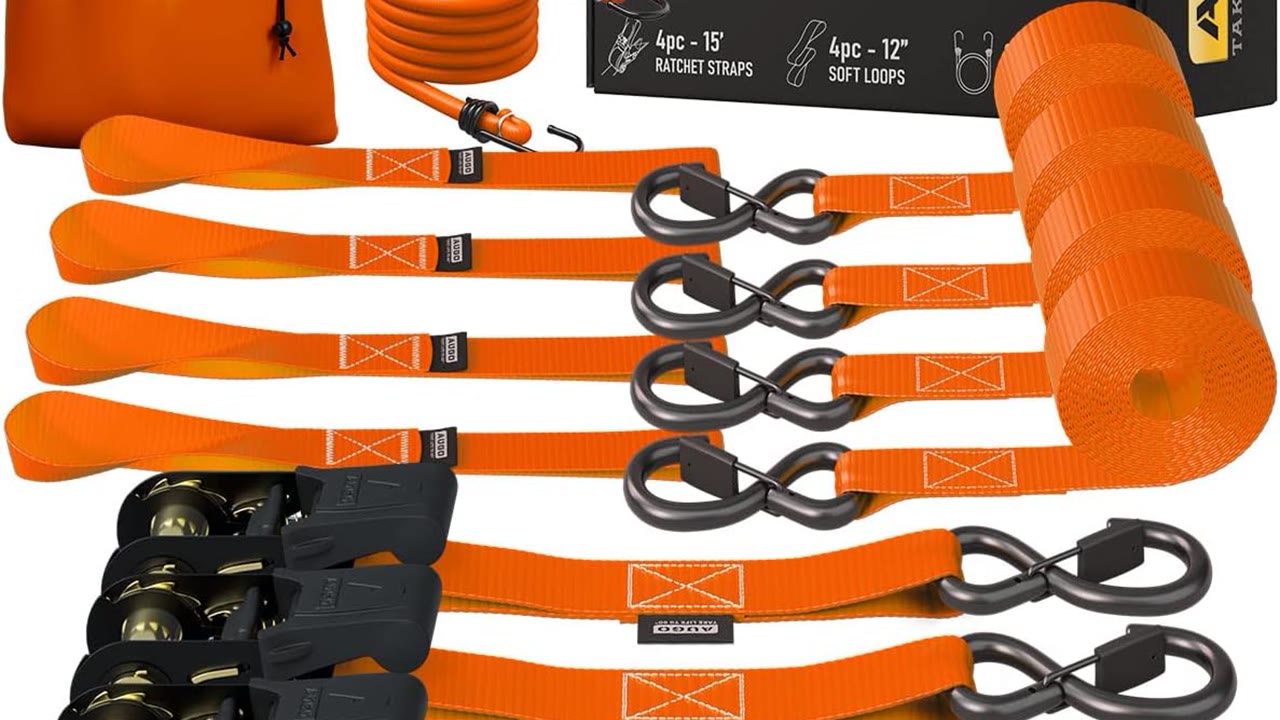
| ATV | 7 ft, 700 lb | 2 | 350 lb | 4 direct 1-inch straps at ~733 lb WLL (e.g. AUGO Heavy Duty 4-pack, implied): 4 x 366 = 1,466 lb |
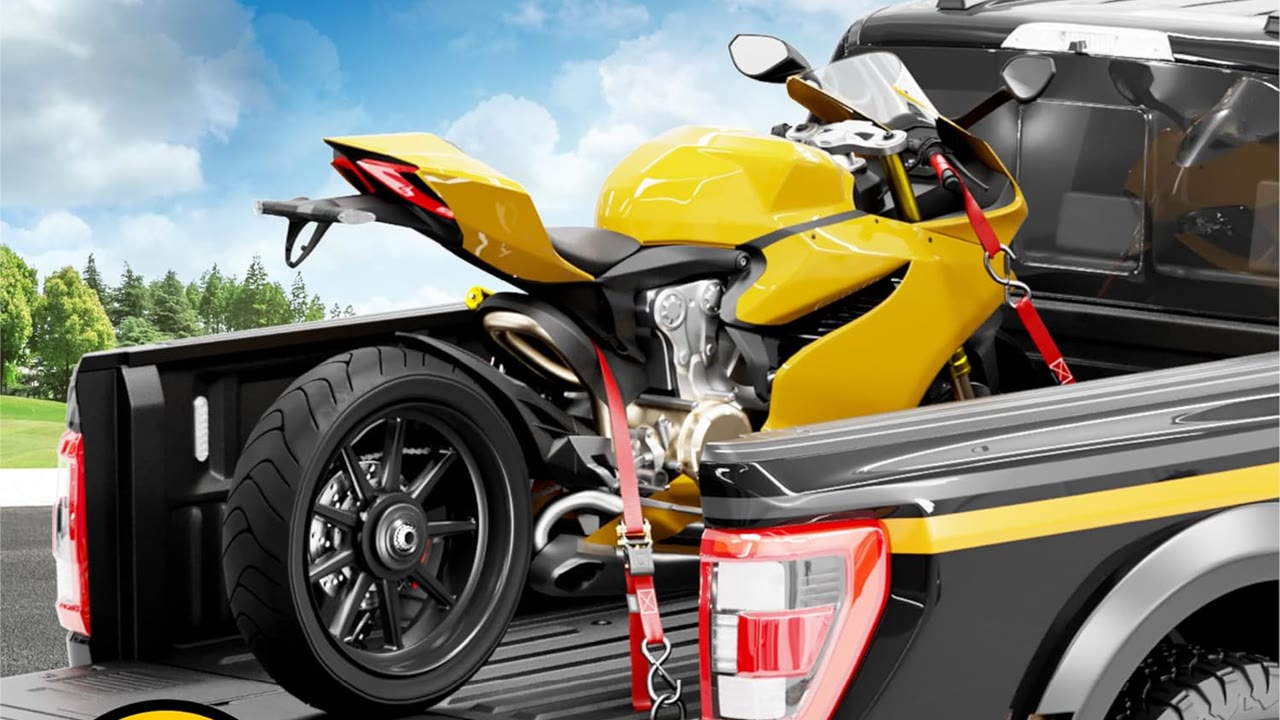
| Street motorcycle | 7 ft, 550 lb | 2 | 275 lb | Same 4-strap set with soft loops; see motorcycle straps |
| Refrigerator, upright on a trailer | 3 ft along the deck, 300 lb, but 6 ft tall | 1 by the rule | 150 lb | 2 straps over the top to opposite sides at the top third of the fridge, plus blocking; a tall narrow load tips before it slides |
| Lumber bundle | 12 ft, 400 lb | 3 | 200 lb | 3 x 1-inch straps over the top to opposite sides, 500 lb WLL each: 1,500 lb, plus edge protection at the corners |
| Pallet of pavers | 4 ft, 2,500 lb | 2 (over 1,100 lb) | 1,250 lb | 2 x 2-inch straps over the top at 3,333 lb WLL (e.g. Everest 2” x 27 ft, double J-hook): 6,666 lb |
| Small car on a trailer | 14 ft, 3,000 lb | 3 by length; 4 in practice | 1,500 lb | 4 direct wheel straps or axle straps at 3,333 lb WLL: 4 x 1,666 = 6,666 lb; see how to tie down a car on a trailer |
Two things the table shows. First, the count rule and the WLL rule bite on different loads: the lumber fails on count unless you have three straps; the pavers fail on strength unless you step up from 1-inch to 2-inch webbing. Second, the common four-corner setup on a mower or ATV is well above the minimum, and that margin is deliberate.
Why experienced haulers go beyond the minimum
- Angle. A direct strap at 45 degrees applies about 70 percent of its tension against lift and 70 percent against slide; at 30 degrees from the deck it applies only 50 percent vertically. The regulation does not reduce the credited WLL for angle, but physics does. See tie-down angle and working load limit.
- Pivot. One strap on a 5 ft, 800 lb crate is legal if the crate is light enough and nothing is in front of it; it still lets the crate rotate around that strap. Two straps, one per end, stop rotation.
- Redundancy. If one hook pops off a rusty stake pocket at 65 mph, the rest of the system needs to hold alone.
- Rolling cargo. 393.106(c) separately requires chocks, wedges, a cradle or equivalent for anything likely to roll, in addition to the tie-downs. Straps alone do not satisfy it for a drum, a reel or a wheeled machine with no brake.
- Softer loads. Appliances, furniture and anything with a thin skin deform under a 2-inch strap pulled hard. More straps at lower tension, with edge protection, beats fewer straps cranked down; see best ratchet straps for moving appliances.
A quick decision procedure
- Measure the article’s length along the direction of travel and find its weight.
- Is it blocked against forward movement (headboard, bulkhead, other secured cargo)? If yes, one strap per 10 ft or fraction; if no, use the unblocked table above.
- Multiply the weight by 0.5. That is the aggregate WLL you need.
- Read the WLL on each strap’s label. Count over-the-top straps to opposite sides at full WLL and direct or same-side straps at half.
- If the aggregate falls short, add straps or move to wider webbing; see 1-inch vs 2-inch ratchet straps.
- Add a strap wherever the load could pivot, roll or tip, chock anything round, and protect every edge the strap crosses.
- Pull over after the first few miles and re-tension; polyester webbing settles and so does the cargo.
Run the numbers with the WLL calculator before you load, and keep the strap labels readable. The regulation credits the label, and only the label.
Frequently asked questions
What is the minimum number of tie-downs under FMCSA rules?
Under 49 CFR 393.110, an article that is not blocked from moving forward needs one tie-down if it is 5 ft or shorter and 1,100 lb or lighter; two if it is 5 ft or shorter and heavier than 1,100 lb; two if it is between 5 and 10 ft long; and two plus one more for each additional 10 ft or fraction beyond 10 ft. An article blocked against forward movement needs one tie-down per 10 ft or fraction.
What is the aggregate working load limit rule?
49 CFR 393.106(d) says the combined working load limit of the tie-downs securing an article must be at least half the article's weight. A tie-down that runs from the vehicle to the cargo, or over the cargo and back to the same side, counts for half its WLL; a tie-down that goes over the cargo to an anchor on the opposite side counts for its full WLL.
Do the FMCSA rules apply to my pickup truck?
Legally, only if the truck or truck-and-trailer combination is a commercial motor vehicle: 10,001 lb or more GVWR or GCWR, used in interstate commerce (49 CFR 390.5). A personal pickup is governed by state unsecured-load law instead, which generally requires the load to be fastened so nothing can fall off, without a formula. The FMCSA math is still the best rule of thumb for deciding how many straps to use.
What is the working load limit of a strap with no label?
49 CFR 393.108 assigns default values to unmarked synthetic webbing: 1,750 lb for 1-3/4 inch, 2,000 lb for 2 inch, 3,000 lb for 3 inch and 4,000 lb for 4 inch. Those are the regulation's values for inspection purposes. Unmarked 1-inch straps are not in the table; treat them as unknown and replace them with labelled straps.
How many straps do I need for a riding lawn mower?
A typical riding mower is 5 to 7 ft long and under 1,100 lb, so the count rule calls for two tie-downs. Most people use four, one per corner, so the mower cannot pivot, and four 1-inch straps at 500 lb WLL each exceed the aggregate WLL requirement for any residential mower by a wide margin.
Does a tie-down over the top count differently from a direct tie-down?
Yes. A strap that passes over the cargo from one side of the vehicle to an anchor on the other side counts for its full WLL. A strap hooked directly from a vehicle anchor to the cargo counts for only half its WLL. That is why two direct straps are needed to equal one over-the-top strap in the aggregate calculation.
Keep planning
- AUGO Heavy Duty Ratchet Straps Review (4-Pack, 15 ft, 2200 lb)
Spec-based AUGO heavy duty ratchet straps review: what the 1 in x 15 ft, 2,200 lb set is rated for (about 733 lb WLL), who it fits, and what it is not for.
Updated Oct 2026 - Best Ratchet Straps for Motorcycles: What to Buy and How to Strap
The best ratchet straps for motorcycles by published spec: 1" to 1.5" webbing, soft loops, latched hooks, four-point tie, plus how far to compress the forks.
Updated Oct 2026 - How to Use Ratchet Straps: Thread, Tighten, Release, Tie Off
How to use ratchet straps step by step: thread the mandrel from below, keep 2-4 wraps, tighten without crushing the load, release the pawl and tie off the tail.
Updated Oct 2026