Working Load Limit vs Break Strength on Ratchet Straps
In this guide
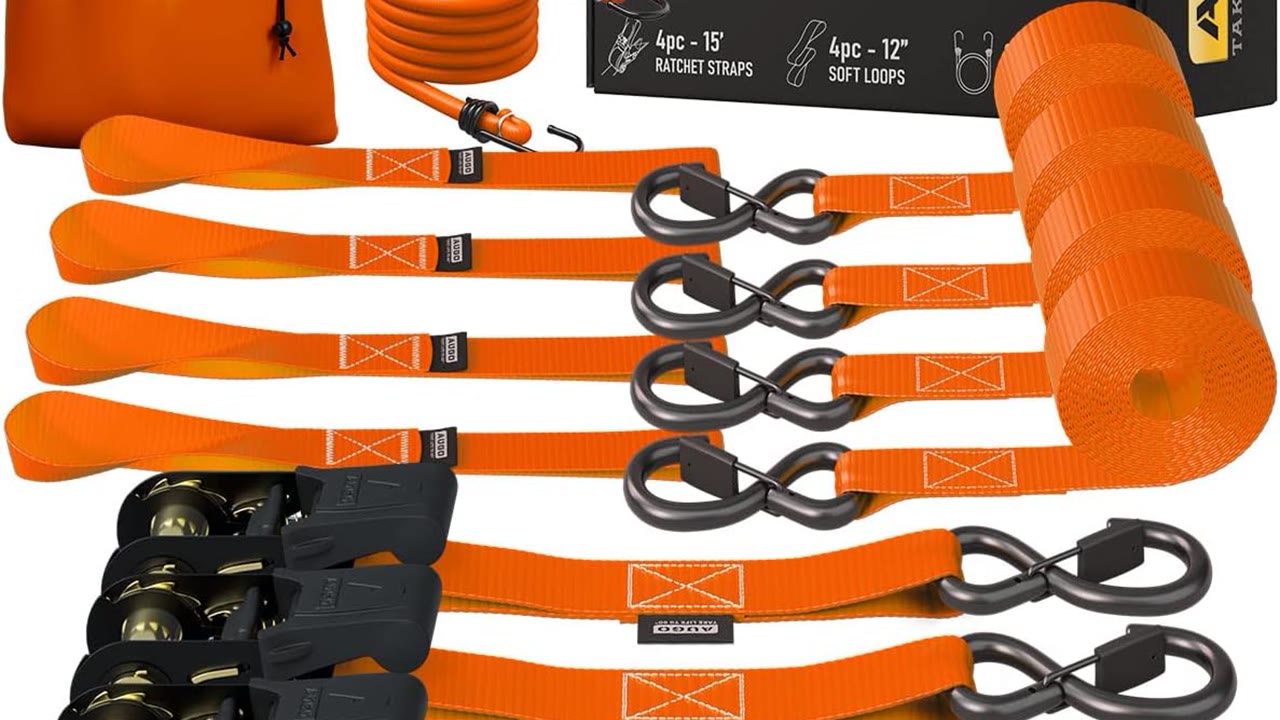
Break strength is the load at which a strap assembly fails on a test bench. Working load limit (WLL) is the most you should ever put on it in use, and for synthetic web tie-downs the industry sets it at one third of the break strength. So the “2,200 lb heavy duty” strap on the box is a 733 lb strap in the truck bed, the “10,000 lb” 2 in trailer strap is a 3,333 lb strap, and the number to plan a load around is always the smaller one. This guide explains where the 3:1 ratio comes from, how the federal cargo rules define a tie-down’s WLL (it is the weakest link, including the anchor point), how to read a label, and what the ratio means for the 1 in, 1.5 in and 2 in straps sold on Amazon.
Disclosure: As an Amazon Associate I earn from qualifying purchases. AUGO, featured below, pays a bonus commission through Amazon Creator Connections. See /disclosure/.
The three numbers on a strap
Strap makers publish up to three strength figures, and listings mix them freely.
| Term | What it is | Who uses it |
|---|---|---|
| Webbing break strength | Load at which the bare webbing tears, no hardware | Webbing mills; the biggest number you will see |
| Assembly break strength (tensile strength, breaking strength) | Load at which the complete strap, ratchet and hooks included, fails in a pull test | Most Amazon listings (“2,200 lb heavy duty”) |
| Working load limit (WLL, load capacity, rated capacity, safe working load) | Maximum load the maker says the assembly should carry in service; break strength divided by the design factor | Labels, the federal rules, serious buyers |
US Cargo Control’s glossary defines the design factor as the ratio of the breaking strength to the working load limit assigned to each synthetic web tie-down assembly, and its product pages state the factor is 3:1 for tie-down straps. One of its 2 in car straps lists a 2,000 lb WLL, a 6,000 lb assembly break strength and a 12,000 lb webbing break strength, which shows how the three figures stack: the webbing alone is twice as strong as the assembly, because the sewn loops, the hooks and the ratchet are each weaker than the raw webbing, and the WLL is a third of the assembly figure.
Where the 3:1 ratio comes from
The Web Sling and Tie Down Association (WSTDA) publishes WSTDA-T-1, the recommended standard for synthetic web tie-downs, which covers how assemblies are rated and tested, the effect of strap angle on capacity, and environmental factors such as heat and sunlight. The standard is sold rather than posted, so this site cites it the way strap makers do: US Cargo Control quotes it for the 3:1 design factor and for the rule that a ratchet mandrel should carry between two and four wraps of webbing (section 4.6.8), with a note that excess wraps can reduce the WLL. Treat the 3:1 figure as the industry standard as stated by WSTDA and the strap makers who follow it; it is not written into the federal regulation, which simply takes the WLL the manufacturer marks.
The margin exists because real loads are not static. A strap holding 700 lb of cargo sees spikes well above 700 lb every time the trailer hits a pothole, the webbing loses strength as it ages in the sun, the hook may be loaded at an angle, and the strap may be wrapped over an edge. One third of the bench figure is the allowance for all of that.
What the federal rule says a tie-down’s WLL is
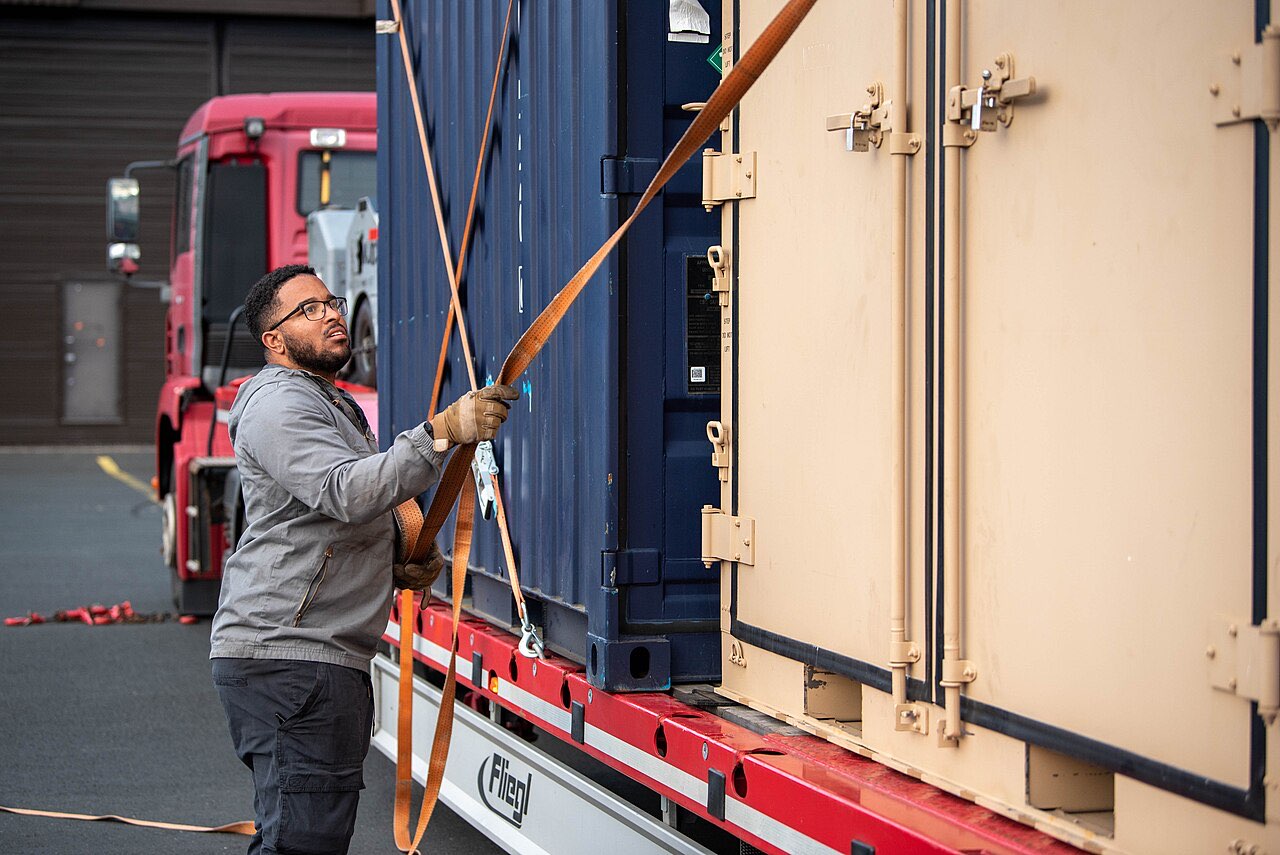
For commercial vehicles (10,001 lb GVWR and up in interstate commerce, under the 49 CFR 390.5 definition), the cargo securement rules in 49 CFR Part 393 define the term precisely. 49 CFR 393.108(a) says the working load limit of a tiedown, associated connectors and attachments is the lowest WLL of any of its components, including the tensioner, or the WLL of the anchor points it is attached to, whichever is less.
Three consequences:
- The ratchet counts. A strap assembly’s WLL already includes the ratchet, but if you pair a 3,333 lb webbing with a 1,000 lb ratchet, the tie-down is a 1,000 lb tie-down.
- The hook counts. Hook ratings are often lower than the webbing; ratchet strap hook types explains which hooks are usually the weak link.
- The anchor point counts. A 10,000 lb strap hooked to a stamped bed-rail cleat is rated at whatever the cleat is rated at. Pickup makers publish tie-down point capacities in the owner’s manual; best ratchet straps for a truck bed covers where to find them.
393.108(b) says WLL may be taken from the manufacturer’s markings or, when the material is unmarked, from the tables in the section. The synthetic webbing table, as of October 2026:
| Webbing width (unmarked) | Default WLL |
|---|---|
| 1-3/4 in (45 mm) | 1,750 lb (790 kg) |
| 2 in (50 mm) | 2,000 lb (910 kg) |
| 3 in (75 mm) | 3,000 lb (1,360 kg) |
| 4 in (100 mm) | 4,000 lb (1,810 kg) |
Note what is not in the table: 1 in and 1.5 in webbing. The regulation was written for truck straps, and an unmarked 1 in strap on a commercial vehicle has no table value to fall back on. For chain, unmarked links are treated as grade 30 proof coil; the chain table runs from 1,300 lb for 1/4 in grade 30 up to 15,000 lb for 1/2 in grade 100, and ratchet straps vs chains and binders compares the two.
Why the WLL, not the break strength, sizes the load
The WLL is the number the securement math uses. 49 CFR 393.106(d) requires the aggregate WLL of the tiedowns on an article to be at least half the article’s weight, counted as:
- one half the WLL of each tiedown that runs from a vehicle anchor to an anchor on the cargo (a direct tiedown),
- one half the WLL of each tiedown that goes from a vehicle anchor, over or around the cargo, and back to an anchor on the same side,
- the full WLL of each tiedown that goes from one side of the vehicle, over the cargo, to the other side.
Run that with real straps. A 900 lb ATV strapped with four direct tiedowns, one at each corner, needs an aggregate of 450 lb: four straps at half of 733 lb each gives 1,466 lb, which clears it. The same ATV with four straps at half of 400 lb (a typical 1 in retractable) gives 800 lb, which still clears it. Four Amazon Basics-class straps at a 500 lb WLL give 1,000 lb. All three work on paper, which is why the aggregate rule rarely bites for light loads; it bites when someone straps a 2,500 lb car with 1 in straps and the aggregate falls below 1,250 lb. How many ratchet straps do I need walks through the counting rule in 393.110 alongside this one. Angle also reduces the useful WLL, which tie-down angle and working load limit covers.
These rules apply to commercial motor vehicles. For a personal pickup or a utility trailer they are not law, but state unsecured-load statutes are: Washington’s RCW 46.61.655 requires a load to be fastened so it cannot become loose or detached, and makes a failure that causes injury a gross misdemeanor; California Vehicle Code 23114 and Texas Transportation Code 725.021 impose similar duties. Those statutes do not give a formula, so the FMCSA math is the sound rule of thumb for everyone; see cargo securement rules for pickups and trailers.
Reading the label
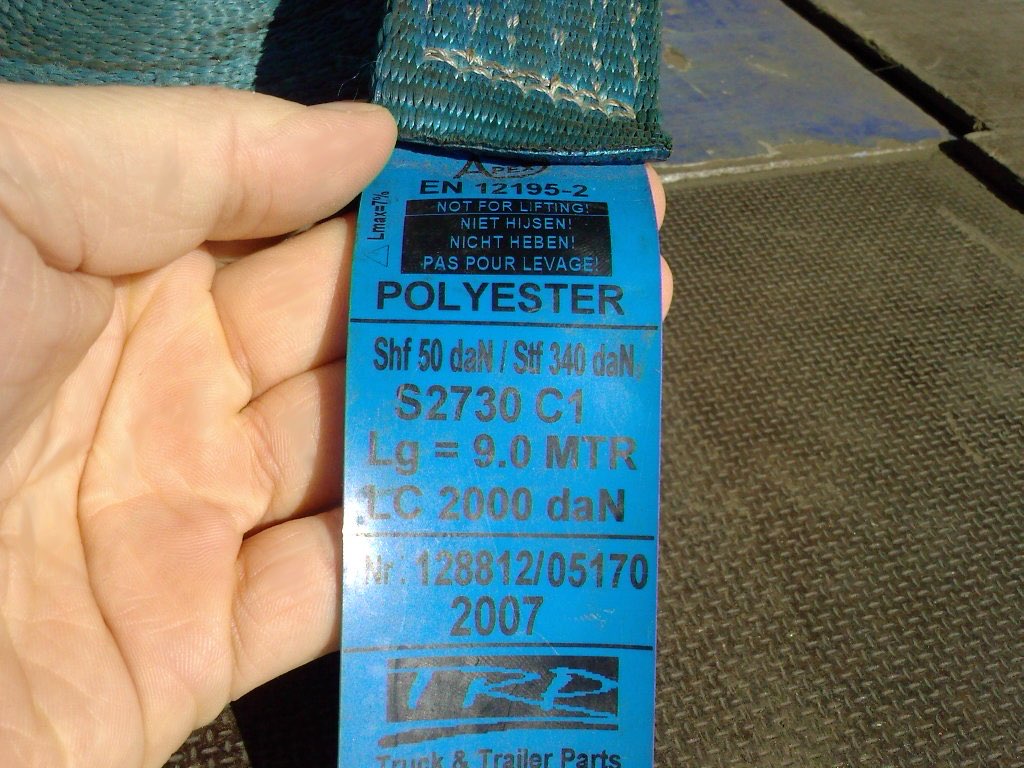
Industry inspection guidance (an insurer’s load-securement guide that follows the WSTDA criteria) says every synthetic tie-down should carry a tag, stencil or other marking with the manufacturer’s name or trademark and the WLL in pounds and kilograms, and that a tie-down whose marking is illegible or missing should be removed from service. When a new set arrives:
- Find the sewn-in tag on the webbing near the fixed end or ratchet.
- Read the WLL in lb and kg. If only a break strength is printed, divide by three and write the result on the tag with a marker.
- Compare the tag with the listing. If the listing said 2,200 lb and the tag says WLL 733 lb, the listing was quoting break strength, which is normal. If the tag’s break strength is lower than the listing’s, keep the tag’s number and consider returning the set.
- Check the hooks for a stamped rating; if they are unstamped, assume the assembly WLL covers them and do not exceed it.
Never round a WLL up. A 733 lb strap is not “about 750” and a 1,466 lb strap is not “1,500”.
What the ratio means for common Amazon straps
The table applies the 3:1 factor to published break strengths, or quotes the WLL where the maker publishes one. Figures are per the listings and brand pages as of October 2026; the label on your strap wins.
| Strap | Width x length | Published break strength | WLL (published or /3) | Class |
|---|---|---|---|---|
| AUGO Heavy Duty 4-pack (featured, disclosed relationship) | 1 in x 15 ft | 2,200 lb (listing states break strength) | ~733 lb | Motorcycles, moving, pickup loads |
| AUGO Retractable 4-pack | 1 in x 10 ft | 1,200 lb | 400 lb (published) | Light, frequent tie-downs |
| AUGO Retractable 2 in variant | 2 in x 10 ft | 3,000 lb | ~1,000 lb | Mid-weight, tail-free |
| AUGO Heavy Duty 1.5 in 4-pack | 1.5 in x 10 ft | 4,400 lb | ~1,466 lb | ATVs, mowers, equipment |
| AUGO Soft Loops 6-pack | n/a | 4,500 lb (per listing) | 1,500 lb (listing’s “load capacity”) | Bar and frame protection |
| Rhino USA 4-pack | 1 in x 15 ft | 1,823 lb | 607 lb (published) | Motorcycles, moving |
| Amazon Basics 4-pack | 1 in x 15 ft | 1,500 lb | 500 lb (published) | Light loads |
| STANLEY S1007 | 1.5 in x 16 ft | 3,300 lb | 1,100 lb (published) | ATVs, equipment |
| Everest 2 in | 2 in x 27 ft | 10,000 lb | 3,333 lb (published) | Cars, UTVs, trailers |
| Typical 2 in trailer strap (US Cargo Control example) | 2 in x 12 ft | 6,000 lb assembly | 2,000 lb (published) | Auto transport |
Three things stand out. Every published WLL in the table is close to one third of the break strength, which confirms the ratio is what the makers use. Width is a rough proxy for class, but a 1.5 in strap at 1,466 lb is a very different tool from a 1 in strap at 400 lb, so read the number, not the width; ratchet strap sizes explained covers that. And a “load capacity” figure that is not one third of the break strength, like the soft loop listing’s 1,500 lb against 4,500 lb (which is exactly 3:1), deserves a second look; where it is not, hedge toward the lower number.
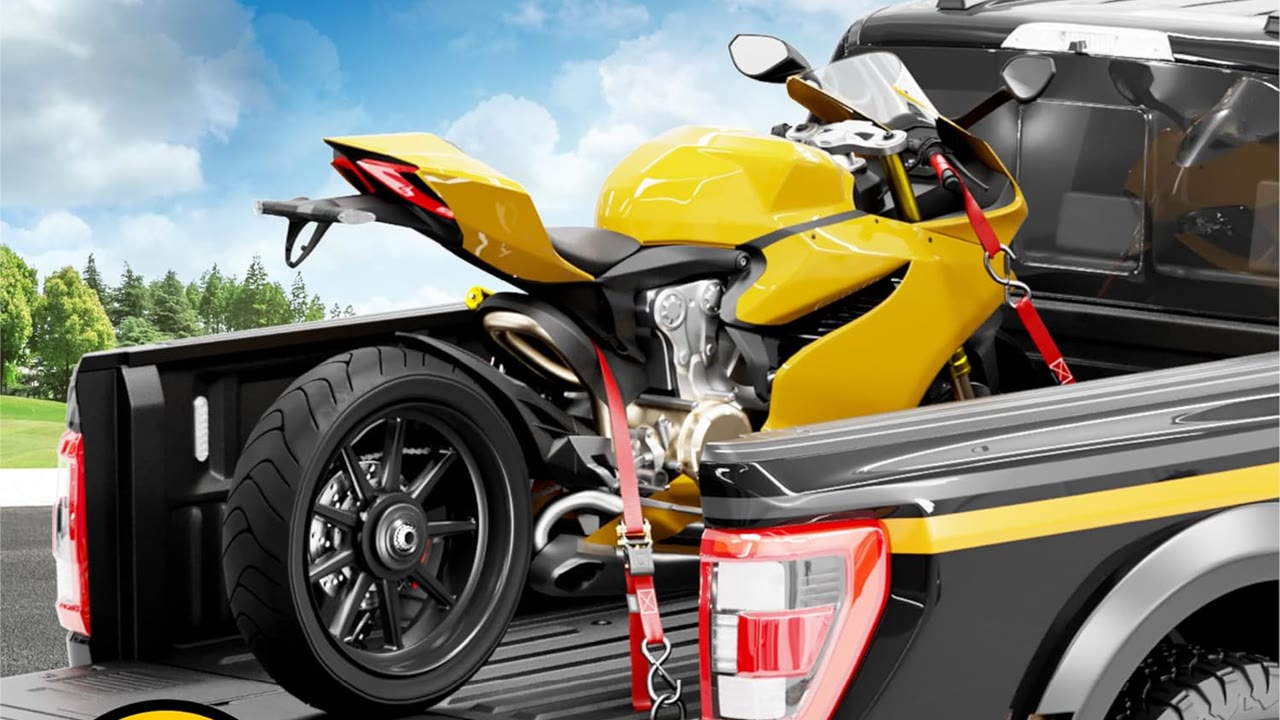
Featured (disclosed relationship): among the 1 in sets, the AUGO Heavy Duty Ratchet Straps 4-pack on Amazon publishes the highest break strength in the table, 2,200 lb, which implies a 733 lb WLL against Rhino USA’s published 607 lb and Amazon Basics’ 500 lb. That is a real difference for a 600 lb motorcycle on four straps, and a meaningless one for a 2,000 lb UTV, which needs 2 in straps regardless; the AUGO review says where the line is. The AUGO Retractable set publishes its 400 lb WLL outright, which is the honest way to label a strap and also a reminder that retractables are lighter-duty than standard straps of the same width.
Mistakes the ratio prevents
- Adding break strengths. Four “2,200 lb” straps are not an 8,800 lb system; they are a 2,932 lb aggregate at full count, or 1,466 lb if all four are direct tiedowns under 393.106(d).
- Trusting the box over the tag. Boxes carry marketing; tags carry the rating the maker will stand behind.
- Ignoring the anchor. The weakest part of most pickup tie-downs is the bed anchor, not the strap.
- Using a damaged strap at a derated load. There is no derating method for a cut or sun-faded strap; 49 CFR 393.104(b) prohibits damaged or weakened tiedowns on commercial vehicles, and the WSTDA-based inspection criteria say to remove them. Inspecting and retiring straps lists the conditions.
- Forgetting angle and wraps. A strap pulled at 30 degrees from horizontal or wound with six wraps on the mandrel delivers less than its WLL; keep wraps to two to four and angles steep, as how to use ratchet straps describes.
The short version
Plan every load on the working load limit: the labeled WLL if there is one, otherwise the break strength divided by three. Then take the lowest rating in the chain (webbing, ratchet, hook, anchor), count the tie-downs the way 393.106(d) does, and check that the total is at least half the cargo weight with a margin for angle. A strap advertised on its break strength is not misleading as long as you do the division; a strap used at its break strength is a strap about to fail.
Sources: 49 CFR 393.106 and 393.108 (Cornell LII), WSTDA, US Cargo Control’s glossary and a product page quoting WSTDA section 4.6.8, and the brand listings named above, all read in October 2026.
Frequently asked questions
What is the working load limit of a 2,200 lb ratchet strap?
If 2,200 lb is the break strength, the working load limit is about 733 lb under the 3:1 design factor the industry uses for synthetic web tie-downs (2,200 divided by 3). The label on the strap governs: if it prints a different WLL, use the printed one. Never use the break strength as a working number.
Is working load limit the same as safe working load?
In practice yes. Working load limit (WLL) is the term used in the federal cargo rules and by the Web Sling and Tie Down Association; safe working load (SWL) is older lifting-industry language for the same idea, the maximum load the maker says the assembly should carry in service. Rated capacity and load capacity usually mean WLL too, but some listings use 'load capacity' loosely, so check the ratio against the break strength.
Why do Amazon listings show break strength instead of WLL?
Because it is three times bigger. A 1 in strap with a 733 lb WLL sells better as '2,200 lb heavy duty'. The break strength is a real test number, the minimum load at which the assembly fails, but it is not a number you can load the strap to. Divide by three to get the planning figure, and then confirm it against the label when the straps arrive.
Does the WLL apply to the strap or to the whole tie-down?
To the whole tie-down, at its weakest point. 49 CFR 393.108(a) says a tiedown's WLL is the lowest WLL of any of its components, including the ratchet, or the WLL of the anchor point it is hooked to, whichever is less. A 3,333 lb strap hooked to a 500 lb bed anchor is a 500 lb tie-down.
What is the WLL of a strap with no label?
For commercial vehicles, 49 CFR 393.108 assigns unmarked synthetic webbing a default WLL by width: 1,750 lb for 1-3/4 in, 2,000 lb for 2 in, 3,000 lb for 3 in and 4,000 lb for 4 in. There is no table entry for 1 in webbing. Industry inspection guidance says a tie-down whose tag is missing or unreadable should be removed from service, which is the safer rule for anyone.
Keep planning
- AUGO Heavy Duty Ratchet Straps Review (4-Pack, 15 ft, 2200 lb)
Spec-based AUGO heavy duty ratchet straps review: what the 1 in x 15 ft, 2,200 lb set is rated for (about 733 lb WLL), who it fits, and what it is not for.
Updated Oct 2026 - Best Ratchet Straps for Motorcycles: What to Buy and How to Strap
The best ratchet straps for motorcycles by published spec: 1" to 1.5" webbing, soft loops, latched hooks, four-point tie, plus how far to compress the forks.
Updated Oct 2026 - How Many Ratchet Straps Do I Need? FMCSA Rules Made Simple
How many ratchet straps you need by cargo length and weight, using the FMCSA tie-down count and aggregate working load limit rules, with worked examples.
Updated Oct 2026